BUYING & FINANCE
The Role of the Judicial Scrivener and Why You Can't Skip One
A Tokyo-based insider explains what a judicial scrivener actually does in Japanese property transactions, how they protect buyers, and what they…
On this page 10
- What is a judicial scrivener and how are they different from a lawyer?
- What is the property registration system they file into?
- What exactly does the judicial scrivener do in a property transaction?
- How do you actually read a registration extract?
- What is a provisional registration and why does it matter?
- Who appoints the judicial scrivener and who pays?
- How much does a judicial scrivener cost?
- What happens if you don’t register?
- Where this goes wrong
- FAQ
TL;DR: The judicial scrivener (shihō shoshi) is a licensed legal professional who prepares and files the ownership registration documents for your Japanese property purchase. Without them, ownership cannot transfer legally. They verify identity at settlement, confirm the title is clean, and protect both parties from fraud. Their fee is typically around ¥100,000–¥300,000 depending on the transaction. The registry they file into is managed by the Legal Affairs Bureau, and registration priority — not contract date, not payment date — determines ownership when there’s a dispute. The buyer pays the registration tax.
At a settlement last year, the judicial scrivener paused everything 20 minutes in. The seller’s name on a government-issued ID didn’t match a document filed with the Legal Affairs Bureau years earlier. A name change — divorce, presumably — not updated across all records.
The judicial scrivener said quietly: “We need to resolve this before anything moves.”
The bank representative looked at his watch. The seller looked embarrassed. The agents looked at the ceiling.
An hour later, with a corrected document retrieved digitally, settlement proceeded. Without that catch, the ownership transfer might have registered under an ambiguous name — a problem that could take years to unwind.
That’s what they do.
What is a judicial scrivener and how are they different from a lawyer?
A judicial scrivener is a licensed legal specialist in Japan, distinct from a general attorney. Their scope is narrower — they can’t represent you in litigation — but within property registration and certain legal document preparation, they’re the specialists.
Passing the judicial scrivener exam is one of Japan’s hardest national tests. The pass rate runs around 3–5% annually.
The confusion for foreign buyers: neither your real estate agent nor your buyer’s agent is a judicial scrivener. The licensed agent licence covers the real estate transaction, not the registration. Separate professional tracks.
From the desk — In the settlements I have sat through, the judicial scrivener is the one person in the room whose job is to stop everything, and the catches I keep seeing are quiet ones: a name that does not match an old filing, a lien nobody flagged. Buyers tend to read their fee as paperwork overhead until the day that pause is the only thing standing between them and a title problem that takes years to unwind. The lesson that took me longest to internalize is that in Japan the registry, not the contract or the receipt, decides who owns the property — which is why I tell every buyer to pull their own extract rather than trust what they are handed.
What is the property registration system they file into?
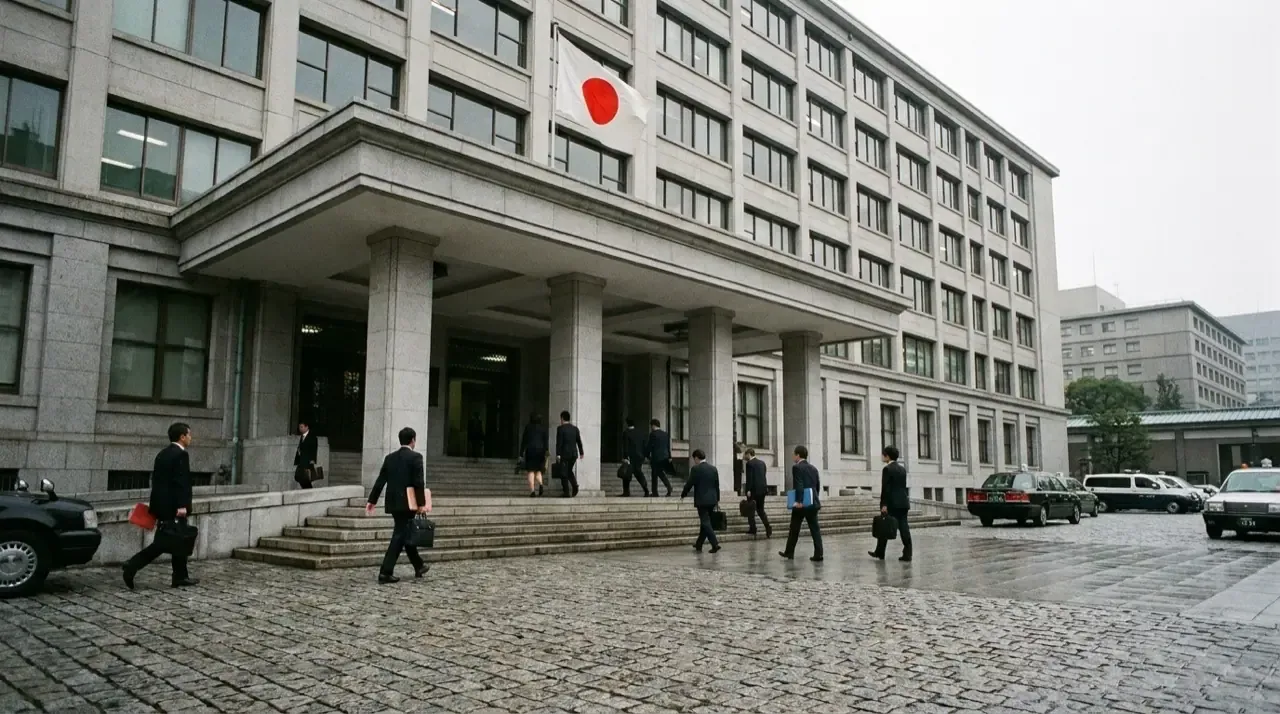
Japan’s property registry is managed by the Legal Affairs Bureau, a branch of the Ministry of Justice. Every parcel of land and every building in Japan has its own registration record. Registration is not mandatory under law — but anyone who fails to register is legally vulnerable to losing ownership to a third party who registers first. In practice, you always register.
The registry is divided into three sections:
Title Section: Physical description of the property. For land: address, area, land category (farmland, residential, etc.). For buildings: address, structure, floor area by level, year of construction. This section is maintained by a land and house investigator, a different specialist from the judicial scrivener.
Ownership Section (Section A): All recorded ownership, including the current owner and full ownership history. If there’s a right of superficies or other use right, it appears here too.
Encumbrance Section (Section B): Mortgages, easements, leasehold rights, and any other encumbrances on the property. When you buy a property and pay off the seller’s mortgage at settlement, the judicial scrivener files a lien release registration here.
What exactly does the judicial scrivener do in a property transaction?
Their work covers two phases.
Before settlement:
They pull the full registration extract and review title history — owners, dates, any mortgages, easements, or restrictions. They verify that the seller has clear authority to sell.
They identify any encumbrances that must be released before settlement — typically the seller’s existing mortgage. They coordinate with the seller’s bank on the payoff amount and timing.
They prepare all registration documents: the ownership transfer, any mortgage registration if you’re borrowing, and lien release for the seller’s old mortgage.
At settlement:
They verify the identity of every person present. For foreign buyers, this means checking passport against all other documents in detail.
They give the signal to proceed with fund transfer. Nothing moves until the judicial scrivener says it can.
They collect all documents needed for filing.
After settlement:
They file at the Legal Affairs Bureau — either in person or electronically — the same day. Priority of registration determines ownership in Japanese law. Filing promptly protects you.
How do you actually read a registration extract?
The judicial scrivener reviews the extract for you — but you should read it too. The registration extract (the official printout of the registry record) can be obtained by anyone from the Legal Affairs Bureau or online (around ¥334 online; slightly more in person).
When reviewing one before purchase, check:
Owner section:
- Is the seller’s name exactly the registered owner? Any discrepancy must be resolved before contract.
- Any recorded ownership claims by third parties?
Encumbrance section:
- Are there active mortgages? These must be released at or before settlement.
- Are there any easements or rights registered that you weren’t told about?
- Any provisional registration? A placeholder reservation — can indicate a pending claim on the property.
Title section:
- Does the registered area match what the agent quoted you? Discrepancies are more common than people expect, especially in older properties.
- Is the building registration consistent with the physical structure? Additions built without registration are unregistered floor area — not illegal to own, but can complicate future transactions and renovations.
What is a provisional registration and why does it matter?
A provisional registration is a placeholder in the registry — it records a pending claim on ownership or a conditional right. Common situations that generate one:
- A buyer has signed a contract but settlement hasn’t occurred yet
- A lender has a conditional security interest
- An inheritance is pending resolution
A provisional registration on a property you’re about to buy is a serious flag. It means someone else may have a claim that will take priority over yours if they convert to full registration before you do. A seller cannot give you clean title with an unresolved provisional registration on the property. Require its release before settlement.
Who appoints the judicial scrivener and who pays?
Convention: the buyer. Specifically, the buyer typically pays for the ownership transfer registration. The seller typically pays for their mortgage lien release. The buyer pays for any new mortgage registration if they’re taking a mortgage.
The judicial scrivener is often introduced by the listing agency or buyer’s agent. This is normal and usually fine — but the judicial scrivener’s duty is to the registration transaction, not to either party personally. They are a neutral professional.
You can bring your own judicial scrivener. For large or complex transactions, this is sometimes worth doing. Some foreign buyers find a bilingual judicial scrivener for additional comfort — they exist, mainly in Tokyo, and charge more.
How much does a judicial scrivener cost?
Their fee has two components:
Professional fee: Roughly ¥80,000–¥200,000 for a standard residential purchase. Complex transactions, multiple registrations, or large property values push this higher.
Registration taxes: Paid by you but collected by the judicial scrivener and remitted to the government. The buyer pays these. Specifically:
- Ownership transfer registration: 2% of the government-assessed value for property tax purposes — not the purchase price. For most Tokyo properties, assessed value runs roughly 60–80% of market price, though this varies.
- Mortgage registration: 0.4% of the loan amount. (Cash buyer, no mortgage registration needed.)
- Seller’s lien release: Seller’s cost, typically minimal — around ¥1,000 per property.
There are reduced rates in some circumstances:
- Primary residence purchases can qualify for reduced rates (confirm current rates as these change)
- New builds have different calculation bases
Total combined cost for a ¥60M apartment: often somewhere in the range of ¥400,000–¥700,000, with the majority being registration tax rather than the professional fee.
The judicial scrivener calculates the precise amount and tells you before settlement. Confirm the number in writing a week before settlement day so there are no surprises.
What happens if you don’t register?
A colleague told me about a case from his early career: a property sold to two different buyers. The first buyer had a signed contract and a receipt for the full purchase price. The second buyer had a signed contract and a completed registration. The second buyer owned the property.
Not a hypothetical legal puzzle. That’s how Japanese property law works.
Without registration, you own the property in a contractual sense — you have a valid purchase contract, you paid, the seller agreed. But Japanese law says that ownership cannot be asserted against a third party without registration.
Practically: if a seller fraudulently sells the same property to two buyers, the one who registers first wins. The unregistered buyer has a claim against the seller for damages — but they don’t own the property.
This is rare but not theoretical. Registration also protects against a seller’s creditors attaching the property after your purchase but before your registration. This is why the judicial scrivener files on settlement day. Same-day registration matters.
Where this goes wrong
- Letting the seller’s agent pick the judicial scrivener without verifying. In a standard transaction this is usually fine. In a transaction where the seller’s agent and buyer’s agent are the same company (dual agency), having the agency’s in-house judicial scrivener handle everything creates a concentration of relationships worth scrutinizing.
- Not confirming document requirements well in advance. The judicial scrivener specifies what documents they need from you. For foreign buyers, the list can be long and some items take weeks to obtain. Get this list at least 30 days before settlement.
- Assuming bilingual service. Most judicial scriveners work exclusively in Japanese. The settlement meeting will be in Japanese. Bring an interpreter for legal Japanese — not just conversational.
- Underestimating registration tax. First-time buyers sometimes budget only the professional fee and are caught short on the registration tax at settlement. Confirm the full estimated amount in writing before the day.
- Assuming assessed value equals market value. It doesn’t. Your registration tax is calculated on assessed value (favorable to you). Your purchase price is market value. Know which number is being used in each calculation.
- Using a judicial scrivener who’s unfamiliar with foreign buyer documentation. Some don’t regularly handle foreign buyer cases and aren’t current on apostille requirements, notarization standards, or accepted document formats. Ask upfront whether they’ve done this before.
- Not verifying the registration extract directly. Your agent should pull this. But pull your own copy too — from the online service or the Bureau directly. The information is public and inexpensive to obtain. Don’t rely solely on what the seller or agent tells you.
- Unregistered additions. The seller says the property has 100 sqm; the registry shows 75 sqm. The extra 25 sqm was added without registration. This area exists physically but isn’t legally recorded — which affects financing, future sales, and sometimes planning compliance. Investigate before signing.
- Not following up on the registration after settlement. The judicial scrivener files the day of settlement. The updated registration certificate comes back within days. Obtain it and keep it. It’s your legal proof of ownership.
- Confusing older and newer registration certificates. Older properties have a paper registration certificate. Newer registrations use a 12-digit one-time ownership identification code. The seller must deliver whichever applies. If they’ve lost it, there’s an alternative identity verification process — time-consuming, not impossible.
Related reading: Buying Tokyo Property Through a Japanese Company: When It Wins.
FAQ
Q: Can a general attorney do what a judicial scrivener does? A: A licensed attorney with the right registration can perform judicial scrivener functions, but most general attorneys don’t focus on registration work. For property registration specifically, the judicial scrivener is the appropriate specialist.
Q: Is it possible to file registration yourself without a judicial scrivener? A: Technically yes. In practice, almost no buyer does this. The registration documents are complex, the filing process is precise, and an error can delay or invalidate the transfer. The professional fee is well worth avoiding the risk.
Q: What if there’s an undisclosed lien discovered by the judicial scrivener before settlement? A: Settlement is paused until it’s resolved. The seller must clear it — their proceeds at settlement typically pay it off. If the lien is large enough that sale proceeds won’t cover it, the transaction gets complicated fast. Your agent should know about this before settlement day.
Q: What if the registry shows a different owner from who I’m buying from? A: Do not proceed. Either the seller has a name discrepancy that needs to be resolved with a legal name-change registration, or something is seriously wrong. Stop, investigate, and consult a professional.
Q: Does the judicial scrivener give me legal advice about the contract? A: No. That’s outside their scope. They handle registration, not contract advice. If you want someone to review your purchase contract for legal risk, engage a general attorney.
Q: Can I look up the ownership of any property in Japan? A: Yes. The registry is public. Anyone can obtain a registration certificate for any property in Japan by providing the address or property ID at a Legal Affairs Bureau, or via the online portal. Ownership is not private in Japan.
Q: Can foreigners be registered as owners in Japan? A: Yes, without restriction. The registry records name, address, and share of ownership. Foreigners appear on the registration the same way Japanese nationals do. There’s no nationality flag in the registry.
Q: How do I verify a judicial scrivener is properly licensed? A: Ask them to show their licence certificate. Their registration is also searchable via the Japan Federation of Shiho-Shoshi Lawyers’ Associations. Legitimate practitioners won’t object to being verified.