STRATEGY & YIELD
A ¥30M Setagaya 1K: Full Yield Breakdown From Gross to After-Tax Cash Flow
A full worked example: ¥30M Setagaya 1K apartment, every cost from gross yield to after-tax cash flow. Line-by-line for foreign investors in Japan.
On this page 8
TL;DR: A ¥30M 1K in Setagaya sounds expensive for a single-room apartment. It also sounds less interesting when the gross yield is 5.8%. Run the full math — gross to net to leveraged cash flow to after-tax — and the picture becomes clearer: not amazing, not a disaster, and almost nothing like the number on the listing sheet. This is what a real analysis looks like.
Setagaya-ku has a reputation. Low yields, expensive land, reliable tenant pool. Landlords there don’t discount much. When a 1K in Sangenjaya clears ¥30M, agents call it “a quality asset.” I call it a spreadsheet problem. Here’s mine.
The deal structure below is illustrative — based on a real property type I’ve evaluated, not a specific transaction. Every number is grounded in current market conditions but represents a range, not a guaranteed outcome.
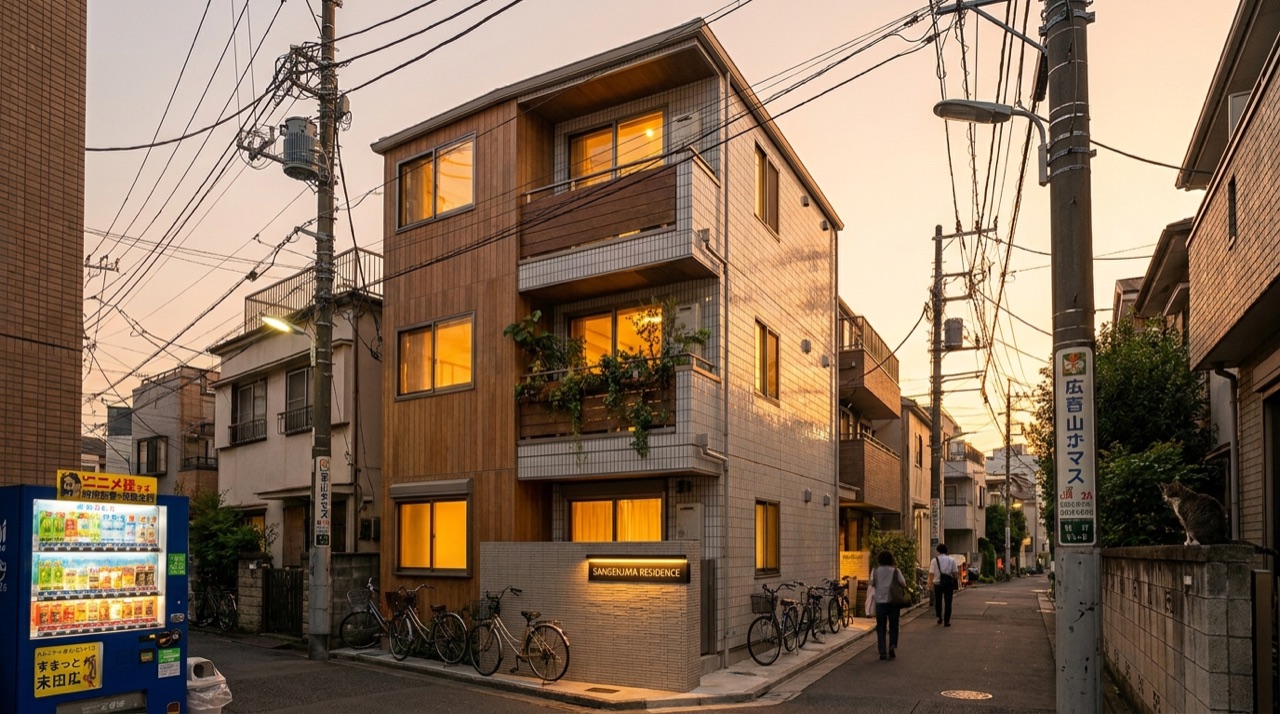
The Property: Sangenjaya 1K, 2008 Build
- Location: Sangenjaya, Setagaya-ku (3 min walk to Sangenjaya Station, Tokyu Den-en-toshi Line)
- Size: 26 sqm
- Build year: 2008 (RC, good seismic spec)
- Floor: 6th of 9
- Asking price: ¥30,000,000
- Current rent: ¥145,000/month (tenant in place, 3 years into contract)
- Listed gross yield: ¥145,000 × 12 ÷ ¥30,000,000 = 5.80%
Looks acceptable for Setagaya. Now take it apart.
From the desk — The pattern I see again and again in Setagaya is buyers anchoring on the listing yield and budgeting their lives around a cash flow that simply evaporates once acquisition costs and debt service hit the page. What actually trips people up here is the special repair levy on these mid-2000s buildings, an envelope arrives one year asking for several hundred thousand yen per unit, and the owner who never modeled it suddenly understands this was always a capital appreciation bet, not an income one.
Step 1: Gross to Net Operating Income
Gross potential rent: ¥145,000 × 12 = ¥1,740,000
Vacancy allowance: 7% (Sangenjaya has tight supply; this is already conservative) Vacancy drag: −¥121,800 Effective gross income: ¥1,618,200
Operating costs:
| Item | Monthly | Annual |
|---|---|---|
| Property management fee (6%) | ¥8,700 | ¥104,400 |
| HOA/common area fee | ¥12,000 | ¥144,000 |
| Building repair reserve | ¥9,500 | ¥114,000 |
| Fixed-asset tax | — | ¥108,000 |
| City planning tax | — | ¥23,000 |
| Fire + earthquake insurance | — | ¥28,000 |
| Minor repairs / maintenance | ¥3,000 | ¥36,000 |
Total operating costs: ¥557,400
Net Operating Income (NOI): ¥1,618,200 − ¥557,400 = ¥1,060,800
Net yield (unlevered): ¥1,060,800 ÷ ¥30,000,000 = 3.54%
Already down from 5.80% to 3.54%. We haven’t touched acquisition costs or financing.
Step 2: Acquisition Costs and True Denominator
Buying this property as a foreign individual:
| Acquisition Cost | Amount |
|---|---|
| Real estate agent commission | ¥1,026,000 (3%+¥60K+tax) |
| Registration license tax | ¥90,000 |
| Real estate acquisition tax | ¥105,000 |
| Judicial scrivener (property registration professional) | ¥90,000 |
| Stamp duty | ¥20,000 |
| Building inspection (optional but recommended) | ¥60,000 |
Total acquisition costs: ¥1,391,000 Total capital deployed (all-cash): ¥31,391,000
Net yield on total capital: ¥1,060,800 ÷ ¥31,391,000 = 3.38%
So 5.80% listed → 3.38% actual unlevered net yield on cash deployed. This is the real baseline.
Step 3: Leveraged Cash Flow (Financing Scenario)
Most foreign investors who can access Japanese financing use a loan. Conditions for non-residents are restrictive, but some regional banks and specialized lenders will extend credit with 30–40% down.
Financing assumption (illustrative; non-resident rates vary):
- Loan amount: ¥18,000,000 (60% LTV)
- Interest rate: 2.8% fixed
- Term: 25 years
- Monthly repayment: approx ¥83,500 (principal + interest)
- Annual debt service: ¥1,002,000
Cash invested at purchase:
- Down payment: ¥12,000,000
- Acquisition costs: ¥1,391,000
- Total equity in: ¥13,391,000
Leveraged annual cash flow:
- NOI: ¥1,060,800
- Debt service: −¥1,002,000
- Pre-tax levered cash flow: ¥58,800
Cash-on-cash return: ¥58,800 ÷ ¥13,391,000 = 0.44%
0.44% cash-on-cash looks terrible. Context: the loan amortizes at roughly ¥460,000/year in principal in Year 1. Total return including equity buildup: approximately ¥518,800. Yield on equity including paydown: 3.87%.
Not exciting. Serviceable — and this is before any appreciation.
Step 4: After-Tax Cash Flow (Non-Resident Individual)
Non-resident individuals earning Japanese rental income pay withholding tax. The payer withholds 20.42% of gross rent unless you appoint a Japanese tax management agent to file properly.
Deductible items for Japan income tax:
- Management fees, taxes, insurance, repair costs
- Depreciation on the building component (RC building: 47-year schedule; purchased second-hand — remaining life calculation applies)
For a 2008 RC building bought in 2025 (17 years old), remaining depreciation life: (47 − 17) + 17 × 20% ≈ 33 years. Annual depreciation on building component:
Building value portion (approx 40% of ¥30M): ¥12,000,000 Annual depreciation: ¥12,000,000 ÷ 33 = ¥363,636
Taxable rental income (illustrative calculation):
- Gross rent: ¥1,740,000
- Less: operating costs (excluding depreciation): −¥557,400
- Less: loan interest (Year 1, approx): −¥504,000
- Less: depreciation: −¥363,636
- Taxable income: ¥315,000 (approx)
Japan income tax on ¥315,000 at marginal rate (5% bracket): ¥15,750
After-tax cash flow: Pre-tax levered cash flow: ¥58,800 Minus income tax: −¥15,750 After-tax cash flow: ~¥43,000/year
On ¥13.4M of equity invested, that’s 0.32% after-tax cash-on-cash.
This is why the Setagaya 1K is not a cash flow play. It’s a total return play.
The Bull Case: Why People Buy This Anyway
Sangenjaya has appreciated steadily. That’s the thesis.
If the property grows 2% annually for 10 years (illustrative scenario): ¥30,000,000 × (1.02)^10 = ¥36,567,000
Less selling costs (~3.5%): net proceeds ≈ ¥35,287,000
Approximate loan balance after 10 years of 25-year amortization at 2.8%: roughly ¥13,200,000.
Equity return at exit: ¥35,287,000 − ¥13,200,000 remaining loan − ¥13,391,000 equity in = roughly +¥8.7M capital gain before tax
Add cumulative after-tax cash flows over 10 years (rough): ~¥430,000 Total return on ¥13.4M equity: roughly ¥9.1M over 10 years
IRR on equity with 2% annual appreciation: approximately 5.5–6.0%
Not bad. Not 8%. For a prime inner-city asset with yen exposure and no FX risk on income, 5.5–6% IRR is a real thesis.
Where This Goes Wrong
The model breaks badly if:
- Appreciation doesn’t materialize. At 0% appreciation, after-tax IRR on equity drops to ~2.5%. You’re taking illiquidity risk for government bond returns.
- The loan rate resets upward. If you’re on a floating rate and Japan rates climb, debt service could rise ¥100,000–¥200,000/year.
- The tenant leaves and rent resets lower. Sangenjaya market rents for a quality 26 sqm 1K might be ¥130,000–¥140,000 now — this tenant at ¥145,000 is slightly above market. The next contract may come in lower.
- Special levy from the building management association. A large repair (elevator replacement, exterior waterproofing) can trigger a one-time special assessment of ¥300,000–¥800,000 per unit. For a 2008 building, this could arrive within 5–10 years.
FAQ
Q: Is Setagaya worth the lower yield compared to eastern wards? Historically, yes — if you’re betting on capital preservation and moderate appreciation. Tenant quality, vacancy rates, and exit liquidity are all better in Setagaya than Adachi or Edogawa. You pay for it in yield compression.
Q: What happens to depreciation when I sell? In Japan, depreciation reduces your acquisition cost basis for capital gains tax purposes. If you’ve depreciated ¥3.6M off the building, your tax basis is lower, and your taxable gain at sale is higher. Model this before assuming the exit is clean.
Q: Can a non-resident get a 60% LTV loan in Japan? Difficult but possible. Some regional credit union banks, specialized mortgage brokers, and Japanese banks with international branches offer non-resident mortgages. Rates and conditions are less favorable than resident rates. Some investors use Japanese companies they own to borrow domestically.
Q: Is ¥145,000/month rent high for a 26 sqm 1K in Sangenjaya? It’s on the high end for the size, but not unrealistic for a newer build with strong station access. The range for comparable units is roughly ¥120,000–¥155,000. The current tenant’s rent being toward the top of range is a mild risk factor at next vacancy.
Q: What’s the all-cash break-even scenario? If you skip the loan: ¥1,060,800 NOI ÷ ¥31,391,000 all-in = 3.38% net yield. With inflation in Japan running at ~2–3%, you’re earning minimal real return on income alone. The all-cash case is entirely an appreciation play.