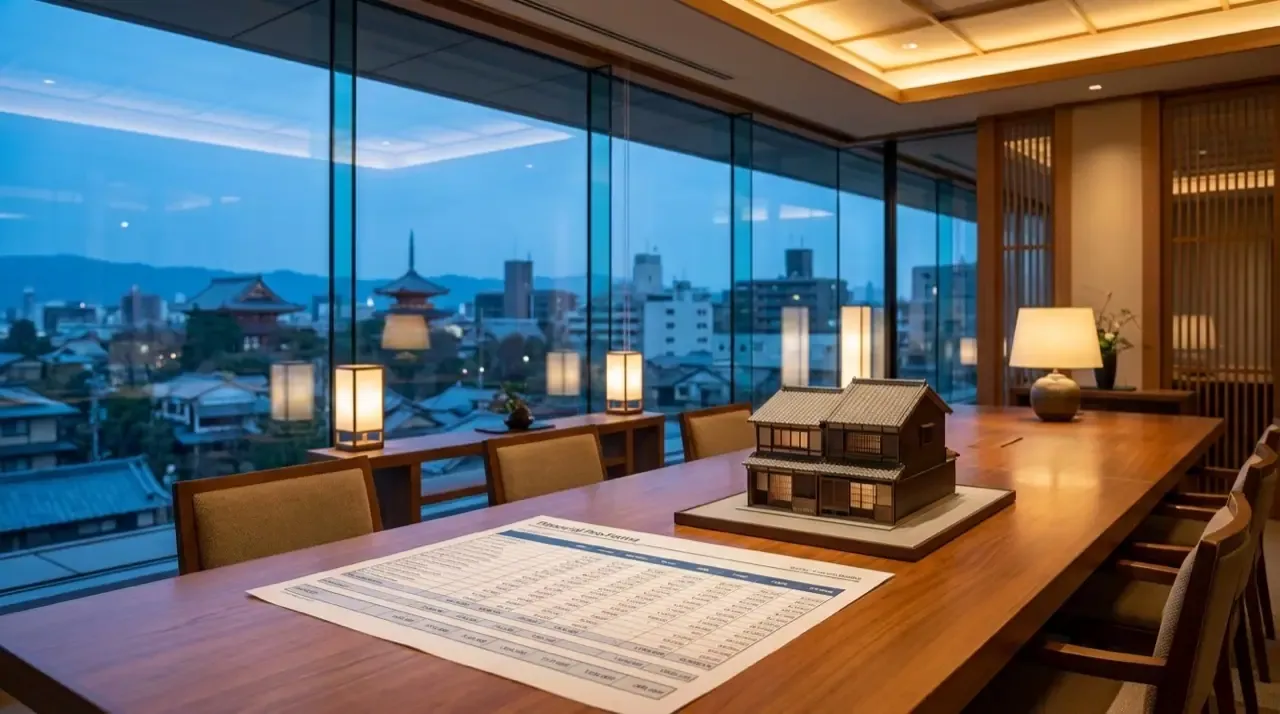
STRATEGY & YIELD
The 180-Day Cap: How Japan's Minpaku Law Reshapes Every STR Pro Forma
Japan's minpaku law caps short-term rentals at 180 nights per year. Here's how that ceiling reshapes your ADR targets, cleaning economics, and net yield math.
On this page 13
- What Does the 180-Day Cap Actually Mean in Practice?
- How Local Municipalities Tighten the National Cap
- Rebuilding the Pro Forma Around the Real Cap
- Why ADR Matters More Than Occupancy Under a Hard Cap
- The Special-Zone Pathway: Where the 180-Day Cap Doesn’t Apply
- What special-zone minpaku (tokku minpaku) actually is
- Where special-zone minpaku actually exists
- The revenue case: special-zone vs standard minpaku
- What the minimum stay requirement means in practice
- The special-zone licensing process
- What the Standard Notification Process Actually Requires
- Where This Goes Wrong
- FAQ
TL;DR: Japan’s Minpaku Shinpou (residential accommodation business law) limits STR operation to 180 nights per calendar year under the standard notification pathway. That’s not 180 available nights — it’s 180 nights of actual guest stays. Your real constraint is tighter than it sounds once you account for cleaning gaps, booking lead time, and local municipal ordinances that can slash the cap further. Model your pro forma around 120–140 bookable nights and the numbers look very different. There is one legitimate way around the cap — special-zone minpaku (tokku minpaku), which allows 365-day operation in designated zones — and it’s covered below, with the revenue math.
I was on a call with a Tokyo property manager last March when her phone buzzed three times. New booking for Golden Week — great — except the unit was already at 162 nights for the year and it was only April 20th. She declined. The revenue was real. The ceiling was real.
The central tension in Japan’s STR market: the demand is there, the margins can work, but the legal framework is hard-wired to limit supply in a way most foreign investors don’t price in before they wire funds.
What Does the 180-Day Cap Actually Mean in Practice?
Japan’s minpaku residential accommodation law came into force June 2018. Under its notification framework, operators who file a notification with their prefectural governor can rent a residential dwelling to travellers. The cap is 180 days per calendar year.
The 180 figure is calendar-year, not rolling 12 months. A unit that opened bookings in September and hits 180 days by year-end cannot “roll over” unused capacity. Each January 1st, the counter resets.
In practice, operators rarely hit 180. A realistic breakdown for a well-managed unit in Tokyo:
| Factor | Days lost |
|---|---|
| Deep cleaning between long stays | 3–5 days/month |
| Mandatory gap days (host policy) | 10–15/year |
| Blocked for personal use | Variable |
| Municipal restrictions (see below) | Up to 90+ days |
| Practical ceiling | ~130–150 nights |
Working with 140 bookable nights is a more honest starting assumption than 180.
From the desk — The most common mistake I see from overseas STR buyers is running the math at 180 nights before anyone has pulled the building management association’s stance or the specific zone’s ordinance, and in this market the association genuinely has the power to kill the plan outright. The operators who actually clear their numbers are the ones who stopped chasing occupancy and started pushing nightly rate, because under a hard cap the night you can’t book is gone, but the rate on the night you do book is the only lever left.
How Local Municipalities Tighten the National Cap
The national law sets 180 days as a maximum. Municipalities can — and do — set lower limits in residential zones.
Kyoto city restricts minpaku in most residential zones to January 15 through March 16 only. That’s roughly 60 days per year, not 180. Osaka’s Namba and Shinsaibashi areas have their own overlay rules. Even within the 23 wards of Tokyo, individual ward governments have passed ordinances restricting operating days in certain zoning categories.
Before you model any cash flow, you need the specific municipal ordinance for the property’s zone. Not the prefecture. Not the ward. The specific zone designation. A licensed Japanese real estate professional or a minpaku management company familiar with that municipality is the right person to check this — not Google.
Rebuilding the Pro Forma Around the Real Cap
Figures below are illustrative — representative of this property type and location, not a guaranteed outcome.
A 2LDK in Shinjuku Ward, full notification pathway.
Assumptions:
- Bookable nights: 140 (after gaps, cleaning, municipal overlay)
- Target occupancy of available nights: 70%
- Nights actually occupied: 98
- ADR: ¥25,000
- Gross Revenue: ¥2,450,000/year (roughly $16,300 USD at 150 JPY — illustrative exchange rate)
Compare that to the “I’ll run it 180 days at 80% occupancy” version many investors model:
- 144 nights × ¥25,000 = ¥3,600,000
That’s a ¥1,150,000 gap before expenses. On a ¥50M property: the difference between a 4.8% and 7.2% gross yield.
The cleaning and OTA fee structure compounds the issue. If OTA fees run 15% and cleaning costs ¥8,000–¥12,000 per turn, your net revenue per occupied night is closer to ¥10,000–¥13,000 after those two line items alone — before management fees, utilities, mortgage, and depreciation.
Why ADR Matters More Than Occupancy Under a Hard Cap
With unlimited nights, occupancy is the lever. Under a hard cap, it becomes secondary to ADR beyond a threshold.
Fill your available nights to ~75%, then try to push to 85% — you add maybe 10 more nights. At ¥25,000 ADR, that’s ¥250,000. Raise ADR by ¥5,000 across all 98 already-booked nights: ¥490,000. Same work, 96% more revenue.
Operators who understand the law optimize for quality guests and higher nightly rates. That’s also why there’s a flight toward special-zone minpaku (tokku minpaku) where the cap doesn’t apply — the next section.
The Special-Zone Pathway: Where the 180-Day Cap Doesn’t Apply
When I explain the 180-day cap to foreign buyers, the first question is always whether there’s a way around it. There’s one legitimate path: buying in a designated special-zone minpaku area.
This isn’t a gray area. It’s a separate licensing regime created by the national government and implemented at the municipal level. The zones are designated. The rules are different. Whether it’s useful depends entirely on where you’re buying.
What special-zone minpaku (tokku minpaku) actually is
Japan’s National Strategic Special Zones Act was created to attract foreign investment and promote economic deregulation in specific geographic areas. One of the deregulation measures within these zones is an alternative short-term rental licensing framework that operates outside the standard minpaku law.
Under special-zone minpaku (tokku minpaku):
- No 180-day annual cap on operating days
- Minimum stay requirement: varies by zone; historically 2–6 consecutive nights minimum
- Licensed directly by the municipality (not the prefecture)
- Physical facility requirements similar to hotel/ryokan in some respects (though lighter than full hotel classification)
- Regular inspections by the designated municipal authority
The critical difference from standard minpaku: you can operate 365 days a year. The critical difference from a hotel/ryokan license: the facility requirements are generally lighter, though not trivial.
From the desk — Every foreign buyer I sit down with asks the same thing within the first ten minutes: is there a way around the 180-day cap? When I point them toward the special-zone path, the pattern I keep seeing is that by the time a property in an established Osaka zone hits the market, the day-cap premium is already baked into the asking price, and the buyers who hesitate are usually the ones who assumed they’d found arbitrage nobody else had.
Where special-zone minpaku actually exists
As of 2025–2026, special-zone minpaku areas are limited to specific locations where the national government has designated National Strategic Special Zones:
Osaka: The most developed special-zone minpaku market in Japan. Osaka’s Nanko/Bays area and other designated zones within the city have active special-zone minpaku licensing. Osaka was the first major implementation and has the most established market data.
Tokyo: Some Tokyo zones have National Strategic Special Zone designation (including parts of Ota-ku historically). However, Tokyo’s ward-level implementation has been less expansive than Osaka. Verify current zone boundaries with a Tokyo-licensed agent — the designations can change.
Other areas: Several regional cities and areas have received National Strategic Special Zone designation for various deregulation purposes. Not all of these include the special-zone minpaku licensing component. Confirm whether a specific location’s designation includes the STR component before modeling on special-zone assumptions.
The zone list is not static. The national government can add or modify designations. Local municipalities can implement the framework or decline to do so even within a designated zone.
The revenue case: special-zone vs standard minpaku
The difference in revenue ceiling is significant. Same property, two license types (illustrative):
| Metric | Standard Minpaku | Special-Zone Minpaku |
|---|---|---|
| Operating days | 180 | 365 |
| Occupancy rate | 65% | 65% |
| Booked nights | 117 | 237 |
| ADR | ¥20,000 | ¥20,000 |
| Gross room revenue | ¥2,340,000 | ¥4,740,000 |
The revenue delta at the same occupancy rate: ¥2,400,000 per year. Over a 10-year hold, that’s ¥24M in additional gross revenue before costs.
Costs don’t stay flat. Cleaning, utilities, and variable management costs roughly double with the doubled booked nights. Fixed costs (property tax, insurance, reserve) stay similar.
Operating cost comparison (illustrative, same 1LDK property):
| Cost Item | Standard Minpaku | Special-Zone Minpaku |
|---|---|---|
| Cleaning (turnovers × ¥10,000) | ¥530,000 | ¥1,078,000 |
| Management (20% of gross) | ¥468,000 | ¥948,000 |
| Utilities | ¥320,000 | ¥450,000 |
| Supplies | ¥150,000 | ¥250,000 |
| Insurance | ¥100,000 | ¥120,000 |
| Property tax | ¥170,000 | ¥170,000 |
| Tools | ¥80,000 | ¥80,000 |
| Maintenance reserve | ¥250,000 | ¥250,000 |
| Total costs | ¥2,068,000 | ¥3,346,000 |
NOI comparison (illustrative):
- Standard minpaku NOI: ¥2,340,000 − ¥2,068,000 = ¥272,000
- Special-zone minpaku NOI: ¥4,740,000 − ¥3,346,000 = ¥1,394,000
The special-zone minpaku generates ¥1,122,000 more NOI per year on the same property. On a ¥30M acquisition, that’s the difference between a 0.9% NOI yield and a 4.6% NOI yield.
What the minimum stay requirement means in practice
Some special-zone minpaku areas historically required a minimum consecutive stay of 6 nights. This significantly affects which travelers can book — business travelers on short trips, weekend tourists, and spontaneous bookers can’t meet a 6-night minimum. More recent special-zone implementations have moved toward 2-night minimums, which is more workable.
The minimum stay affects your occupancy assumptions. A 6-night minimum in Osaka effectively targets a different market segment (extended-stay leisure travelers, relocating expats, digital nomads) than a 2-night minimum property. ADR may be lower per night for longer stays due to length-of-stay discounts, but cleaning cost per night is significantly lower (fewer turnovers on longer stays).
If a special-zone area in your target location has a 2-night minimum, it operates much like a standard minpaku in terms of market access. If it’s 6 nights, factor the changed guest profile into your ADR and occupancy assumptions.
The special-zone licensing process
Unlike standard minpaku notification (prefectural government), special-zone minpaku licensing goes through the municipality — typically the city or ward office in the designated area.
General process (illustrative, varies by zone):
- Pre-consultation with the municipal STR authority: confirm the property address is within the designated zone and the facility meets baseline requirements
- Application submission: property photos, floor plans, facility compliance documentation
- Site inspection: municipal officials inspect the property
- License issuance: timeline varies, typically 2–4 months
- Annual compliance: some zones require periodic reporting
The facility requirements vary by zone but generally include minimum room size, ventilation, fire safety basics, and sanitation standards. Not as demanding as f
Related reading: Modeling a Kyoto Machiya STR: ADR, Occupancy, and the 180-Day Ceiling.
ull hotel/ryokan in most cases — but not trivial.
What the Standard Notification Process Actually Requires
Back on the standard pathway: filing a notification is not a license application. You’re notifying the prefectural governor that you intend to operate. But the checklist is substantial:
- Proof of property ownership or lessor consent (critical: many standard leases prohibit subletting)
- Floor plan showing the unit meets safety requirements
- Fire alarm and extinguisher installation (required by law)
- Neighbor notification (you must notify adjacent residents; many buildings require building management association approval)
- Management system documentation if you’re not on-site (registered minpaku management company required for remote hosts)
That last point bites foreign investors hard. If you’re not physically present in Japan and not a registered manager, you need to hire one. Registered management companies charge 10–25% of gross revenue. Add that to your model.
Where This Goes Wrong
- Investors model 180 days without checking municipal restrictions first. In Kyoto this mistake is catastrophic.
- Assuming building management association consent is a formality. In Japan’s condo market, the management association has real authority. Many actively prohibit minpaku.
- Forgetting the calendar-year reset. Operators who launch mid-year sometimes run hard at the cap, then face a dead first half of the following year if they don’t manage pacing.
- Underpricing ADR to fill nights when the cap makes high occupancy less valuable than high rate.
- Not modeling cleaning economics at the per-turn level. At 98 turns per year × ¥10,000/turn, that’s ¥980,000 just in cleaning — close to 40% of gross revenue in this illustrative example.
- Special-zone misidentification. Marketing materials for some properties claim special-zone minpaku eligibility based on proximity to a National Strategic Special Zone designation, not confirmed inclusion. Verify the specific property address is within the licensable zone boundary. This requires confirming with the municipality, not inferring from a map.
- Municipalities have pulled back. Some local governments within designated zones have not implemented special-zone minpaku or have added local restrictions that approach the standard minpaku framework in restrictiveness. Designations at the national level don’t guarantee permissive implementation at the city level.
- Special-zone acquisition premiums. Properties in established special-zone minpaku areas in Osaka are priced with the income potential reflected. You’re not finding this arbitrage hidden in the market — buyers who know this framework already bid up qualifying properties. The NOI advantage shown above may already be capitalized into the purchase price.
- The minimum stay cuts into market reach. A 6-night minimum Osaka property competing against Kyoto’s 2-night minpaku options faces a narrower traveler funnel. Get honest about the demand for extended stays in your specific location before assuming standard occupancy rates.
FAQ
Can I roll unused days from one year to the next? No. The 180-day cap is per calendar year. Unused days do not carry forward.
Does the 180-day cap apply to my entire property or per room? The notification is per dwelling unit. A house with three rooms rented separately requires separate notifications and each unit has its own 180-day cap.
What happens if I exceed 180 days? Operating beyond the cap is unlicensed accommodation in violation of Japan’s hotel and ryokan business law. Penalties include business suspension orders, fines, and in repeat cases, criminal referral. OTA platforms are increasingly cooperating with municipal governments on compliance checks.
Can I avoid the cap by listing under my own name and a management company’s name alternately? No. The cap applies to the dwelling unit, not the registered operator. Trying to cycle operators to reset the counter is a violation.
Is there any legal pathway to operate more than 180 days? Yes: special-zone minpaku (tokku minpaku), covered above, and the hotel/ryokan license both allow unlimited days. Both have significantly higher compliance burdens.
Is special-zone minpaku available in any Tokyo wards today? Ota-ku in Tokyo had special-zone minpaku designations in prior years. Current availability and boundaries should be confirmed directly with Ota-ku’s relevant department and a local agent. Tokyo’s special-zone minpaku market is much smaller than Osaka’s.
Can I convert an existing standard minpaku registration to special-zone minpaku? These are separate licensing regimes. You’d need to apply for the special-zone minpaku license separately; the standard minpaku registration doesn’t transfer. If your property is in a qualifying zone, you’d apply for the special-zone minpaku license through the municipality.
Does special-zone minpaku remove all municipal STR restrictions? No. Noise ordinances, waste disposal rules, building regulations, and other local rules still apply. Special-zone minpaku removes the 180-day cap; it doesn’t create a regulation-free zone.
Do I need a Japanese entity to hold a special-zone minpaku license? Similar to a hotel/ryokan license, special-zone minpaku licensing typically requires a Japanese legal entity or individual. Foreign investors generally need to structure through a Japanese company. Confirm requirements with the specific municipality.