WARDS & MARKETS
Chuo Ward Guide: Ginza, Nihonbashi & Tsukishima — Prestige vs Tower Liquidity
Chuo Ward means Ginza's luxury strip, Nihonbashi's finance core, and Tsukishima's tower belt.
On this page 10
- What does property cost in Chuo Ward?
- Is Nihonbashi a good place for foreign buyers?
- Why the Marunouchi spillover is the story for Yaesu and Nihonbashi
- The Nihonbashi expressway is coming down, and that is a real catalyst
- What’s the deal with Tsukishima and the tower market?
- How does Chuo compare to Minato for a foreign investor?
- What about Ginza specifically as a residential address?
- How a foreign buyer should play the Yaesu–Nihonbashi side
- Where this goes wrong
- FAQ
TL;DR: Chuo Ward sits between Minato’s expat premium and the Bay Area tower belt — and it’s less understood by foreign buyers than either. Ginza is prestige but limited in pure residential stock. Nihonbashi is where Tokyo’s finance crowd actually lives, and with Marunouchi’s office market full, the Yaesu–Nihonbashi side of Tokyo Station is where the trophy-office money is now landing. Tsukishima offers the most liquid condo market in central Tokyo. Yields here beat Minato. So does transaction volume.
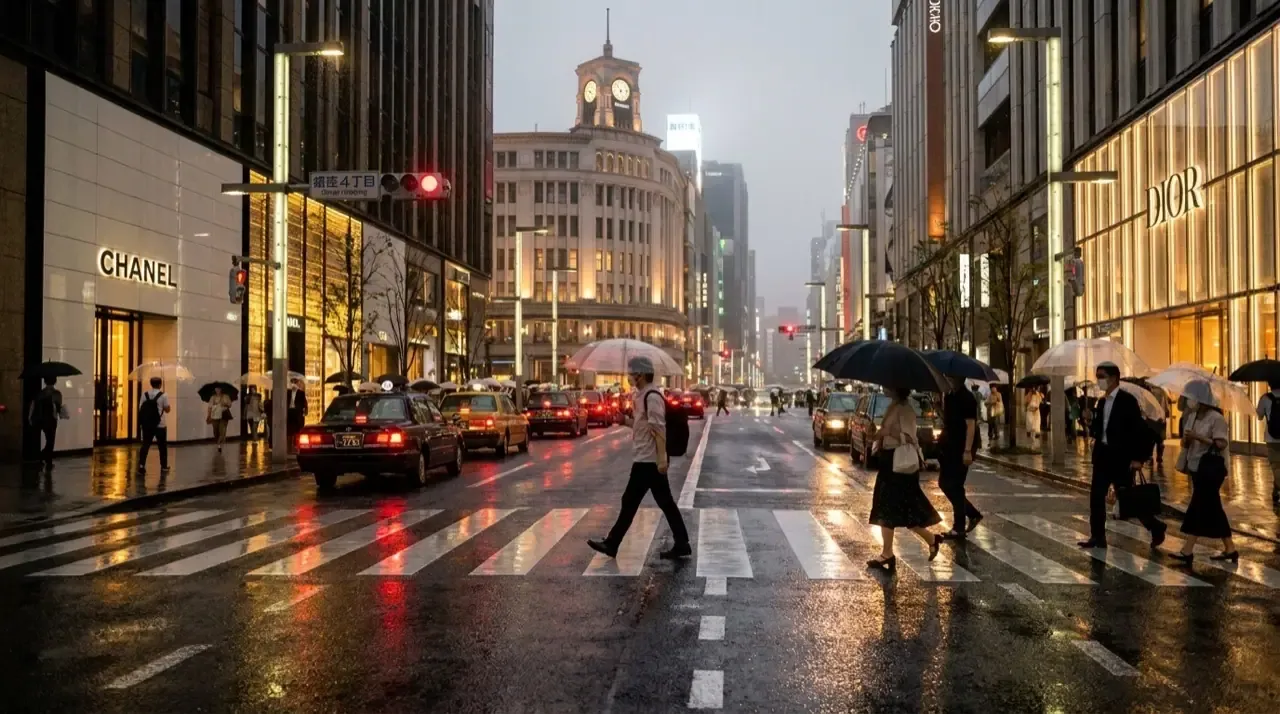
Stand at the Ginza 4-chome crossing at 8 p.m. on a Saturday. Hermès tower to your left, the Wako clock tower ahead, taxis in every direction. Walk six minutes northeast. You’re in Nihonbashi — quieter, older, the original commercial center of Edo Japan. Keep walking fifteen minutes east. You’re on Tsukishima, a reclaimed island of low-rise shitamachi neighborhoods getting steadily absorbed by tower condominiums.
Three distinct real estate personalities. One administrative area.
What does property cost in Chuo Ward?
Prices vary significantly by sub-area.
Ginza: Residential stock is thin. Most of the ward’s surface area here is commercial. Where apartments exist — typically upper floors of mixed-use buildings — you’re looking at roughly ¥1.5M–¥2.2M per sqm for quality stock. What exists trades on address value more than utility.
Nihonbashi / Kayabacho / Hatchobori: The core residential corridor for Chuo, anchored by the Tozai and Hibiya lines. Pricing runs around ¥900,000–¥1.5M per sqm depending on age and spec. New build towers from the 2018–2024 window push toward the upper end. Resale mid-range is more findable.
Tsukishima / Kachidoki / Harumi: The tower belt. High-rise supply is dense. Prices run roughly ¥800,000–¥1.3M per sqm, with newer buildings and higher floors commanding the premium. The Athletes’ Village redevelopment (Harumi Flag) has injected significant new supply — worth watching.
For the new-build tier, treat these as directional, as of writing:
- New condos in Chuo-ku, which covers Nihonbashi and Ginza, broadly run in the 100 to 110 million yen range per unit, with central-Tokyo new stock averaging around 1.7 million yen per square meter.
- Central Tokyo, Chiyoda, Chuo and Minato, has seen new-condo pricing up more than 20% year on year, and the count of 100-million-yen-plus launches has surged.
- At the top, the Waldorf Astoria Residences Tokyo Nihonbashi, Asia-Pacific’s first under that brand, will sit on floors 48 to 51 of the Midtown Nihonbashi tower, 71 units from roughly 60 to 430 square meters, with move-ins from autumn 2027. Pricing is not public, which is itself the signal: this is a buy-the-brand-and-the-service product, priced accordingly.
The takeaway is not the headline number, it is the spread. You can play Nihonbashi at the 100-million-yen mainstream-luxury tier or at the branded-residence ultra tier, and both sit on the same trophy-office foundation.
From the desk — Across the closings I work in this ward, Nihonbashi is the one buyers walk past on the way to a flashier address and then regret not weighing more seriously, while the same people overpay for a Tsukishima tower without registering how much resale supply is still queued behind it. The hesitation I watch most often is around reclaimed-land risk, and the buyers who actually read the liquefaction map end up calmer and choose their floor better.
Is Nihonbashi a good place for foreign buyers?
It’s underrated. Nihonbashi was Tokyo’s commercial center for 400 years. The Mitsui main store is here. The Bank of Japan is here. The ward has spent the last decade in serious urban renewal, and the 2035 expressway decking project — covering the raised highway over the Nihonbashi river — will be transformative when complete.
Nihonbashi is also, not coincidentally, Mitsui Fudosan’s ancestral base. The company has been running a multi-decade “neighborhood creation” program here, and it is now entering its loudest phase. Tokyo Midtown Nihonbashi, the fourth Midtown after Roppongi, Hibiya and Yaesu, is being built around the roughly 284-meter Nihonbashi Nomura Mitsui Tower, 52 storeys, with the overall project structurally completing in September 2026 and the full complex opening in autumn 2027 (directional). The retail piece, the COREDO Nihonbashi area, closes in late 2026 to be folded into the new commercial zone.
What this does to nearby homes is straightforward. A new Midtown is a demand magnet for premium office tenants, hotel guests and retail, and the residential stock around it, mostly mid-2010s and newer condos in Nihonbashi 1- to 3-chome, gets re-rated as the surrounding address improves. You are buying the halo, not the tower.
For foreign buyers, the practical advantage is the Tozai Line, with direct access to Otemachi, Nihonbashi, and Tatsumi. The neighborhood is quiet by central Tokyo standards. Grocery options and restaurants are solid. International school proximity requires a commute, but it’s manageable.
The Japanese-language barrier is more present in Nihonbashi than in Minato. Fewer English-speaking agents, fewer English-first management companies. Not a dealbreaker — budget for professional translation support.
Why the Marunouchi spillover is the story for Yaesu and Nihonbashi
Marunouchi and Otemachi, the slab of Grade A towers on the west side of Tokyo Station, are effectively full. Class A vacancy in that submarket sits around 0.7% as of writing (directional), which is not a market, it is a queue. Rents there run roughly 36,000 yen per tsubo per month and have been climbing for several straight quarters.
When the best business address in Japan has no space and no slack, demand does not evaporate. It walks across the tracks. The Yaesu side of Tokyo Station, and Nihonbashi just beyond it, are the overflow valve, and the big developers have spent the last decade pre-building for exactly that flow. This is the single most important thing to understand about buying here: you are not betting on a neighborhood becoming fashionable. You are betting on an office market that is already maxed out pushing its tenants, and their salaries, one block east. “Spillover” is a thesis, not a guarantee, but the supply constraint on the Marunouchi side is real and physical, and that is what makes this more than a story.
Yaesu, the east exit of Tokyo Station, used to be the scruffy back door, low-rise, dated, forgettable. That is over.
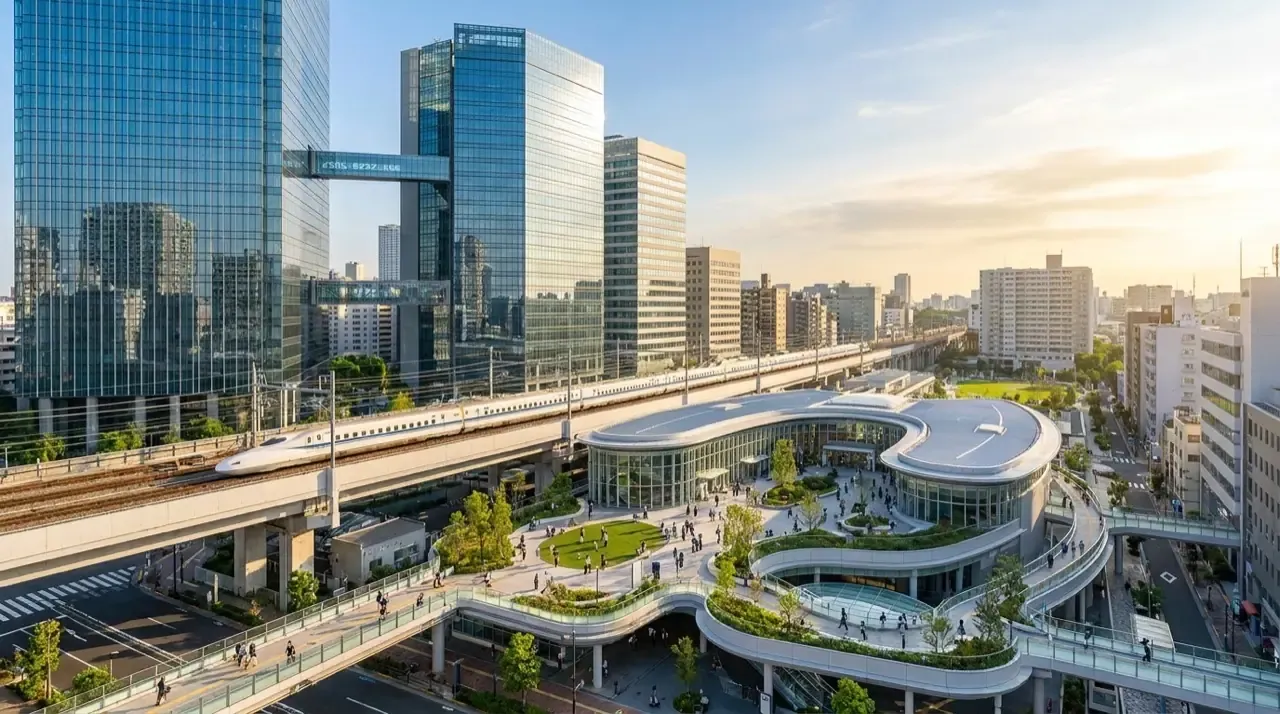
Tokyo Midtown Yaesu opened fully in March 2023, anchored by the 240-meter Yaesu Central Tower, with the Bulgari Hotel Tokyo occupying the top floors and a new long-distance bus terminal buried beneath it. Mitsui Fudosan put roughly 240 billion yen into it (directional). It reset the entire block’s address tier overnight.
Right next to it, TOFROM YAESU TOWER, a Tokyo Tatemono project of around 250 meters and 51 floors, completed in February 2026, connected directly into Tokyo Station via the Yaechika underground mall. Its sister building, TOFROM YAESU THE FRONT, is slated to finish the block in mid-2026. These are mixed-use: offices, retail, medical, conference and MICE space, a bus terminal, and a residential component on top.
That residential component is the point for you. There is very little housing in Yaesu proper, so the apartments that sit inside or beside these towers are scarce by construction. Scarcity plus a station-front, trophy-office address is the cleanest version of the spillover trade.
The Nihonbashi expressway is coming down, and that is a real catalyst
For 77 years an elevated expressway has run directly over the Nihonbashi bridge, the literal historic center of Japan’s road network. Tokyo is burying it.
The underground replacement tunnel is targeted to open around fiscal 2035, with full removal of the overhead viaduct by fiscal 2040, a project costed at roughly 320 billion yen (directional). The payoff: an open-sky waterfront roughly 100 meters wide and 1,200 meters long, minutes from Tokyo Station, where there is currently a concrete deck and traffic noise.
This matters for a buyer with patience. Waterfront-restoration projects in dense cities reliably lift adjacent residential value, and this one runs on a published government and developer timeline rather than a rumor. The honest read: 2035 to 2040 is a long hold, and you are paying today partly for a view that arrives later. If your horizon is three years, discount it. If it is ten-plus, it is a genuine tailwind few other Tokyo districts can offer.
What’s the deal with Tsukishima and the tower market?
Tsukishima is the most liquid residential market in central Tokyo by transaction volume. The reason is straightforward: lots of it, relatively standardized (tower condos built to similar specs across a 30-year range), and a tenant pool that is large and predictable — young professionals, couples, finance-sector workers.
Gross yields here run roughly 2.8–4.0%, meaningfully better than Minato. On a ¥70M unit renting at ¥220,000/month, that’s around 3.8% gross. Net after management and vacancy probably 2.8–3.2%. Still not high by global standards, but workable.
The capital appreciation question is more complicated. Tsukishima and Kachidoki have appreciated, particularly post-2013, but the supply pipeline has been heavy. Harumi Flag — over 5,000 units constructed for the 2020 Olympic Athletes’ Village — is the largest single residential complex in Japan. When all phases hit the resale market, it will affect comparable pricing in the sub-area. Be more cautious on capital appreciation here than in Nihonbashi or Ginza.
How does Chuo compare to Minato for a foreign investor?
| Factor | Minato | Chuo |
|---|---|---|
| Prestige / Address | Higher | Medium-high |
| Yield (gross) | 2.0–3.5% | 2.8–4.0% |
| Transaction volume | Medium | High (Tsukishima) |
| Foreign expat infrastructure | Strong | Moderate |
| New supply risk | Low | Medium-high (Harumi) |
| Price per sqm | ~¥1.2–2.5M | ~¥800K–1.5M |
Chuo makes more sense if yield matters to you and you’re comfortable without the Minato expat network. It also makes more sense if budget is a real constraint — you get more square meters for the same money.
What about Ginza specifically as a residential address?
Set realistic expectations. Ginza is one of the most recognized addresses on earth. It genuinely commands a premium from Japanese buyers and certain overseas buyers for whom the name carries weight.
As a residential experience, though, it’s primarily a commercial district. Street-level noise, weekend crowds, limited quiet green space. The apartments that exist here often carry high management fees given the mixed-use complexity.
I’d take Motoazabu over Ginza for daily livability at comparable price points. Ginza makes sense for pied-à-terre buyers who want the showpiece address and will use the unit occasionally — not for someone who wants a primary Tokyo home.
How a foreign buyer should play the Yaesu–Nihonbashi side
For a foreign buyer, the most underrated feature of Yaesu and Nihonbashi is exit liquidity. Property next to a maxed-out CBD, with direct Tokyo Station access (Shinkansen, Narita and Haneda links, a dozen-plus rail lines), sells to the deepest possible pool: domestic institutions, relocating executives, and overseas buyers who all recognize the address without a map. You are not relying on a niche of buyers who happen to like a particular neighborhood.
That is the difference between a trophy-adjacent asset and a lifestyle asset. When you eventually sell, “200 meters from Tokyo Station, next to Tokyo Midtown” is a sentence that closes deals in any market. Compare that with a charming-but-obscure address that needs explaining.
A few honest, practical moves:
- Buy the halo, not the trophy. The towers themselves are mostly office and hotel. Your asset is the scarce residential stock around them. Map which buildings sit inside the 5-to-8-minute walk shed of Midtown Yaesu, TOFROM YAESU and Midtown Nihonbashi.
- Separate the timelines. The Yaesu office spillover is happening now. The Nihonbashi waterfront is a 2035-2040 payoff. Price each accordingly, and do not pay 2040 prices for a 2026 view.
- Decide your tier. Mainstream luxury around 100 million yen for liquidity and rental depth, or a branded residence if you want managed, hands-off ownership and a name that travels globally.
Use our ward guides to compare Chuo-ku against Chiyoda and Minato, run the numbers on holding costs and yield in our tools, and put two target buildings side by side in compare before you fly in.
Related reading: Shinagawa & Takanawa Gateway: Tokyo’s New Southern Hub.
Related reading: The Train Line Station Premium on Tokyo Property: What You Pay For Access.
Where this goes wrong
- Harumi Flag supply overhang. The phased release of Harumi Flag units into the resale market over 2024–2030 will add competitive supply in the Tsukishima/Kachidoki/Harumi sub-area. The appreciation story is complicated there.
- Flood and liquefaction risk. Chuo Ward — especially Tsukishima, Kachidoki, Harumi — is reclaimed land with documented liquefaction risk in a major earthquake. Check the Tokyo liquefaction hazard maps. Not a reason to never buy, but it should affect which building and floor you choose.
- Older buildings near Kayabacho / Hatchobori. Stock from the 1980s exists in this area. Some hasn’t been retrofitted to post-1981 seismic standards. Verify the seismic inspection documentation.
- Overestimating short-term rental income. Tsukishima is not an obvious tourist destination. If you’re modeling minpaku income to juice yield, occupancy assumptions here are harder to defend than in Asakusa or Shinjuku.
- Limited English-language property management infrastructure. Compared to Minato, you’ll need to work harder to find bilingual management support. Budget for it.
Related reading: Shinjuku Ward Guide: Kagurazaka Charm vs Kabukicho Risk.
FAQ
Is Chuo Ward safe from a flood risk perspective? Parts of Chuo, particularly the reclaimed island areas, are in Tokyo’s flood risk zones. The ward has flood walls and drainage infrastructure, but in a sustained heavy rain event or levee failure, low-lying areas are at risk. Upper floors of tower buildings significantly reduce exposure.
Can I get short-term rental approval in Chuo Ward? Under Japan’s Minpaku Law, short-term rentals are allowed up to 180 nights/year nationwide, but many ward-level regulations and homeowners association rules restrict this further. Chuo Ward allows minpaku in principle but individual building rules often prohibit it. Check the building regulations before buying with this in mind.
Is Harumi Flag worth buying now? One of the most contested questions in Tokyo real estate right now. The discount from market at original sale was real. Resale buyers need to be careful about supply competition from other phases. I’d want to see how the first resale cohort settles before buying here.
What’s the commute like from Tsukishima to major business districts? Tsukishima (Yurakucho Line and Oedo Line) puts you at Otemachi in roughly 12 minutes, Shinjuku in around 25, Roppongi in about 20 via Oedo. Well-connected. The Yurakucho Line link is underappreciated.
What are the best buildings to target in Nihonbashi for a first purchase? I can’t name individual buildings here, but the general guidance: post-2000 build date, monthly management fee reasonable relative to size, reserve fund adequately funded, and proximity to the Tozai Line exits. Ask your agent to pull the long-term repair plan documentation as part of due diligence.